
Brenda Ayres
Completed Fiction Seeking Traditional Publisher
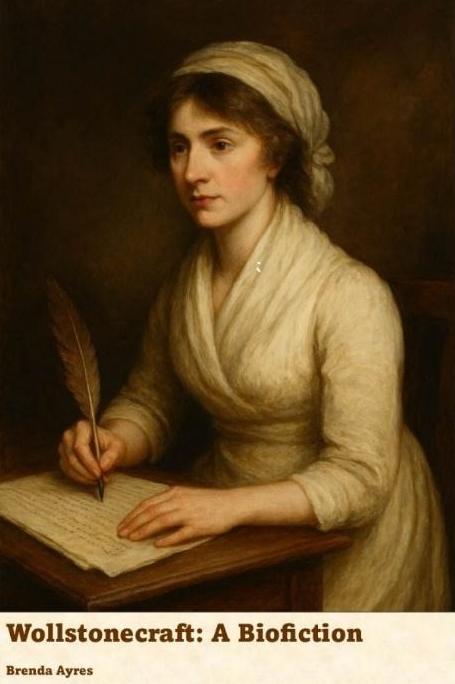
Mary Wollstonecraft has frequently been called the Mother of Feminism. Throughout fiction and nonfiction, she has also been depicted as a deist, agnostic or atheist, an apostate, rebel, and/or lesbian. After having identified 1010 references to the Bible in her seminal A Vindication of the Rights of Woman (1792), Ayres views her as a Bible-believing Christian, a woman who made mistakes but through them, learned of God’s forgiveness and grace. Wollstonecraft also came to believe that God created women to be equal to men and therefore should be granted equal education and vocation on this earth. This biofiction, titled simply Wollstonecraft, tells her life story through a Christian perspective and with considerable scholarly documentation.
Billie Pole was born between two worlds, between the Choctaws and the Nanishtahoolo—that is, everyone else. She grew up in Pearl River, Louisiana, to parents who were social climbers and wanted very little to do with their Indian heritage and relatives, much less to do with Billie’s sister born with Down Syndrome. Billie’s story begins in 1919 as a young woman of sixteen, newly aware of her sexuality and restless to venture out into the word beyond the last stream of the bayous. She journeys to an address listed in her cherished Sears catalog, the only link she has had with the outside world. Chicago promises opportunity, adventure, and most of all, freedom. Little did she know when she made her trek north, she would have to face many challenges that threatened to fragment her identity. There would be disappointments and calamity, but Billie is nothing if not resilient. With a new-found faith born in the wake of Moody evangelism in Chicago, Billie’s hard-knock experiences season her into a world-wise, confident. Once she is an old woman who has outlived four husbands, she returns to the cabin of you youth, coming full circle in her worldview. There is earth; there are things of the earth, tied to the earth. Then there is spirit, things not bound to the earth. Living inside a body is a spirit that yearns to be free but will not be set free until her body ceases and releases her spirit to the Lord.


Allyson Downing is a university professor who has decided to take a sabbatical and return to Baton Rouge, where she grew up. There she plans to give tours through a plantation house called Greenbriar while writing a novel set in Antebellum Louisiana. The owner of the plantation is the charming and handsome Richard Barnett, who seems to have one if not both feet in the nineteenth century. Does he fall in love with Allyson or does he continue to love Anabelle Boudier, who, according to her tombstone in the family cemetery, has been dead since 1850? Another thing Allyson is not quite sure of is if the plantation house is haunted. The stories of the residents from the early nineteen hundreds draw her into the past, so much so that, like Richard, she loses her footing in the twenty-first century. She is both enamored and haunted by the past. Can two people live happily ever after if they live like ghosts?
Jayne Williams has a dream and that is to become a bestselling author. She lives inside a world of fiction and does not do well with life outside of it. She dares to leave her safe but boring home in Hickory Plains, Arkansas, for the big city where she lands a job with the New York Post. Eventually she becomes a secretary to John York, a popular reporter. He falls in love with her, but her own ambitions drive her to marry the editor-in-chief Leonard Selasky. Her marriage quickly becomes unbearable in that Selasky is abusive and sadistic. She turns to John for help, who has since married a wealthy CEO of a literary agency. John and Jayne carry on an affair until its discovery by Selasky, who then nearly beats his wife to death. Once released from a hospital, Jayne escapes to Canada and there will spend the next sixteen years isolated in the mountains raising her daughter Lenore. Both Jayne and Lenore will become successful novelists. After her mother’s death, Lenore is forced to deal with other people when she rescues them from a plane trash. The relationships that develop lead her to return with them to New York to search for her father. There she discovers a world full of deception, betrayal, and violence that she comes to despise. It has taught her to value the healing, life-giving properties of the gingko tree, a tree that she readily found in the city’s parks but also one that entreats her to return to her mountain. When she leaves, however, she will not be alone, for she marries a kindred spirit beneath the branches of the gingko tree