Books

Silent Voices: Forgotten Novels by Victorian Women Writers
silent

Some of the greatest English novels were written during the Victorian era, and many are still widely read and taught today. But many others written during that period have been neglected by scholars and modern readers alike. A number of these novels were written by women and were popular when published. Moreover, they reveal perspectives of 19th-century British culture not present in canonized works and therefore revise our understanding of Victorian life and attitudes. With the increasing interest in revising Victorian history and gender scholarship, especially through the rediscovery of lost texts written by women, this book is a timely and much needed study.

The expert contributors to this volume argue the value of novels by such Victorian women writers as Grace Aguilar, Catherine Crowe, Charlotte Elizabeth Tonna, Annie E. Holdsworth, Ella Hepworth Dixon, Flora Annie Steel, Anne Thackeray, Sarah Grand, Marie Corelli, and others. Most of the chapters address numerous works by a particular writer. Each focuses on different social issues as well, though most of them share an interest in gender politics. Topics discussed include a 19th-century Jewish novelist's navigation through Protestant spirituality, the relationship of noncanonical governess novels to class and gender issues, and forgotten works by women crime writers. Other chapters analyze how women writers impelled social reform and subverted patriarchally defined religious issues.

Silent Voices: Forgotten Novels by Victorian Women Writers Read More »
Frances Trollope and the Novel of Social Change

france

Victorian writer Frances Trollope has largely been relegated to a mere footnote in literary history as simply the mother of Anthony. Equally unfortunate is that, aside from her nonfiction work Domestic Manners of the Americans, her 34 novels have been out of print since the nineteenth century. She was, nonetheless, the most provocative female writer of the early Victorian period who used the novel to impel social change. She has been credited for writing the first anti-slavery novel that predates Uncle Tom's Cabin, along with a number of works that incited reform legislation regarding bastardy clauses, poor laws, and labor conditions.

Expert contributors examine her life and writings, her social activism, and the impact of her works. The book includes discussions of her influence on Anthony Trollope, the rivalry between Frances Trollope and Charles Dickens, her belief in the power of female friendship, her ambivalence toward the ability of women to effect social change, her thoughts on Evangelicalism, her views on women and aging, and her innovative contribution to early crime fiction. Contributors argue for the value of reprinting her novels and travel books and point to her enduring literary legacy.

Frances Trollope and the Novel of Social Change Read More »

Dissenting Women in Dickens’ Novels: The Subversion of Domestic Ideology

des

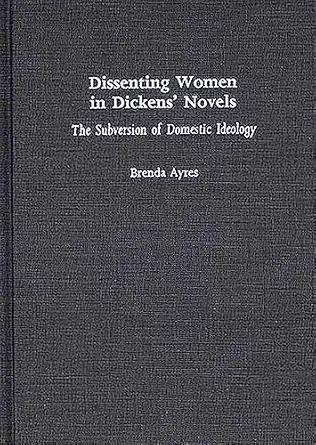
Given their pedagogical nature, many Victorian novels are highly politicized; their narratives are filtered through the value schemes, social views, and conscious purposes of their authors. Victorian women were largely expected to dedicate themselves to the social and moral betterment of their families. Women were expected to be soft, meek, quiet, modest, submissive, gentle, patient, and spiritual; men were supposed to be aggressive, assertive, resilient, disciplined, and competitive. These expectations were repeatedly endorsed through the conduct books of the period, which encouraged people to adhere to proper behavior. The Victorian era also viewed fiction as a didactic tool and as a means to propagate morality. Thus novels of the period typically present women as subordinate to men and as angels of the home. Women who conform to the social norms are usually rewarded in these fictitious worlds, whereas women who violate society's standards are often penalized.

Certainly the novels of Charles Dickens fall into the larger didactic trend of Victorian fiction, and like other works of the period, his novels overtly support the conventional values of Victorian society. Dickens typically uses descriptive detail to register approval or disapproval of certain women, and these women are rewarded or chastized through his plots. But on a less obvious level, Dickens also challenges the prevailing Victorian attitude toward women. A close look at his works shows that patriarchs do not automatically deserve the respect they command from their privileged social positions. Women―however virtuous―are unable to produce moral or social change, and many women succeed outside the constraints of domesticity. This book provides a penetrating analysis of how Dickens' novels ultimately fail to promote the conventional Victorian behavioral ideal for women and discusses how his works subvert the domestic ideology of the nineteenth century.

Dissenting Women in Dickens’ Novels: The Subversion of Domestic Ideology Read More »

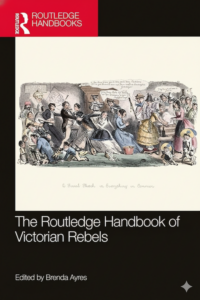
The Routledge Handbook of Victorian Rebels

book1

Although history records that the British nineteenth century was obsessed with order, conventionality, and conformity, there were many Victorians from all walks of life, across lines of class, race, and gender, who resisted social mores and sometimes the laws themselves, in a variety of ways and to varying degrees. Some expressed dissension through music, art, literature, and social protest. Others were more subtle like manipulative wives who gained what they wanted while seemingly remaining docile and submissive. Some rebellion fermented into social and political movements. The revolt of still others were extremely executed by serial killers, criminals, and suicides. Contemporary readers can learn from these rebels and discern what values and ways that were uniquely Victorian should be retained and those that should be rejected after having observed their outcomes. To that end, this collection of essays offers a study for both novice and expert on Victorian rebels.

The Routledge Handbook of Victorian Rebels Read More »

Becoming Mary Wollstonecraft: The Interconnection of Her Life and Works

new project

Becoming Wollstonecraft: The Interconnection of Her Life and Works draws from biography to explain her works, and it analyses the works to draw a biographical composite of Wollstonecraft. Becoming Wollstonecraft will be more fully developed than previous works, with added information that has not previously been associated with Wollstonecraft, such as the story of Reverend Mr. Joshua Waterhouse.

Although there are over fifty book-length biographies published on Wollstonecraft, very few agree on much about Wollstonecraft. She seems to have become an “everywoman,” or a figure unfixed in time and protean. Deemed the Mother of Feminism, like feminism itself, she is what people have wanted her to be and is by no means an immutable or universal personage.

A study of her life as evident by her works and vice versa, this monograph intends to refocus the image of Wollstonecraft for students and scholars, informed by biographical texts on Wollstonecraft and on those people in Wollstonecraft’s life and acquaintance, historical context, and exposition from her works.

Becoming Mary Wollstonecraft: The Interconnection of Her Life and Works Read More »

Scroll to Top